Edges Exist Everywhere: How Disciplined Casino Players Identify Low-House-Edge Games and Win More by Playing Less
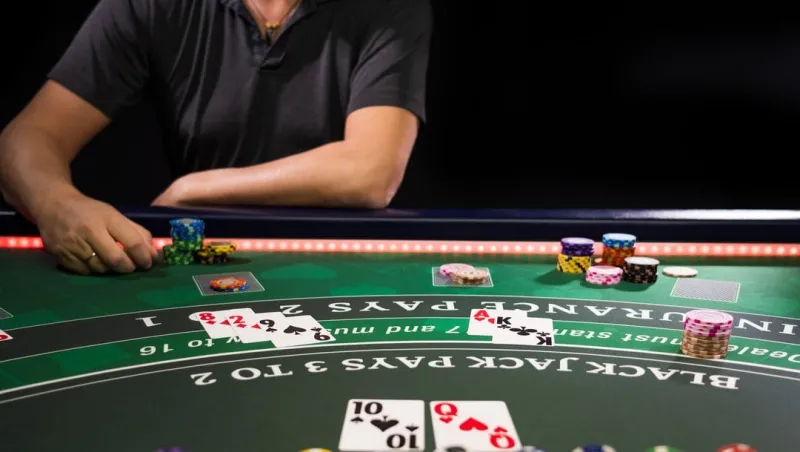
Photo: professional casino player analyzing blackjack cards at table, via casino.betmgm.com
The Game Before the Game
Before a professional bettor places a single chip, they have already made their most important decision: which game to sit down at. While recreational players gravitate toward whatever looks exciting or recently paid out, disciplined casino players understand that the house edge is not a uniform tax. It varies dramatically by game, by variant, by rule set, and sometimes by the time of session. Knowing where that edge compresses—and when conditions favor exploiting variance—is the foundation of professional casino play.
At W88 Pro, the approach to casino gaming mirrors the same analytical rigor applied to sports betting. The goal is not to find entertainment. The goal is to find edge.
Understanding House Edge as a Mathematical Reality
The house edge represents the percentage of each wager the casino expects to retain over a statistically significant sample. A 5% house edge on a $100 bet does not mean you lose $5 on every hand. It means that across thousands of hands, the casino's take averages $5 per $100 wagered. In the short run, variance creates enormous deviation from that expectation. Professionals understand both the average and the deviation—and they exploit the gap between them.
The critical insight is this: a lower house edge means less ground to overcome, fewer hands needed to recover from a cold streak, and more opportunities for positive variance to produce a winning session. Game selection is risk management in its purest form.
Blackjack: The Professional's Benchmark
No casino game has been studied more rigorously than blackjack, and for good reason. Under optimal basic strategy—a mathematically derived decision framework covering every possible player hand against every dealer upcard—the house edge in a standard six-deck game drops to approximately 0.5%. Some single-deck variants, under favorable rules, push that figure below 0.3%.
Rule variations matter enormously. A game that pays 3:2 on a natural blackjack holds a meaningfully lower edge than one paying 6:5, which adds roughly 1.4% to the house advantage. Surrender options, soft 17 rules, and re-splitting allowances each shift the edge by measurable fractions. Before sitting down, professional players assess the complete rule set—not just the table minimum.
Card counting, while legal, is not required to play blackjack profitably at the recreational level. Mastering basic strategy alone eliminates the vast majority of the house's mathematical advantage and places the disciplined player in the best available position relative to the odds.
Video Poker: Where Skill and Payout Tables Intersect
Video poker occupies a unique position in the casino ecosystem. Unlike slot machines, which offer no strategic input, video poker rewards correct decision-making with a published, verifiable return-to-player percentage. Full Pay Deuces Wild, played with perfect strategy, carries an RTP of approximately 100.76%—technically a player edge, though one that requires flawless execution across thousands of hands to realize.
More commonly available variants like 9/6 Jacks or Better—named for the payouts on a full house and flush respectively—return approximately 99.54% under optimal play. That 0.46% house edge is among the lowest available in any casino environment. The key word is "optimal." Deviation from correct strategy erodes that RTP figure rapidly. A single misstep on a high-stakes hand can negate hours of disciplined play.
Professional video poker players memorize strategy charts specific to each variant and payout table. They also identify machines by their payout schedules before playing, recognizing that two machines labeled identically can carry meaningfully different RTPs based on their pay tables.
Baccarat: The Underrated Professional Choice
Baccarat carries a reputation as a high-roller game, but its mathematical profile makes it accessible and attractive to any disciplined player. The Banker bet carries a house edge of approximately 1.06%, and the Player bet sits at roughly 1.24%. The Tie bet, by contrast, carries an edge exceeding 14% and should be avoided entirely by anyone applying analytical thinking to their session.
What makes baccarat particularly valuable is its simplicity. There are no strategy decisions to execute, no charts to memorize, no complex rule variations to track. The player selects Banker or Player, and the game resolves mechanically. For professionals who want to extend their session time in a low-edge environment without the cognitive load of blackjack strategy, baccarat is an efficient choice.
The standard 5% commission on winning Banker bets is already factored into the 1.06% edge figure. Some casinos offer commission-free baccarat variants that alter the payout structure on certain Banker wins. These variants require separate edge analysis, as the commission-free structure does not always represent an improvement in real expected value.
The Timing Dimension: When Variance Works in Your Favor
Game selection addresses the structural edge. Timing addresses the variance component. Professional players understand that the same mathematical edge behaves differently depending on session length, stake size relative to bankroll, and the natural clustering of outcomes that variance produces.
Short sessions in low-edge games create windows where positive variance can produce meaningful wins before the house edge has time to assert itself statistically. A 0.5% house edge in blackjack means very little over 50 hands. It becomes increasingly predictive over 5,000. Professionals who play short, disciplined sessions with clearly defined exit thresholds—both for profit targets and loss limits—are deliberately exploiting the variance window before the long-run averages compress their results.
This is not superstition. It is applied statistics. The expected value of a session does not change based on session length, but the probability of finishing above breakeven shifts significantly in shorter samples, particularly in low-edge games.
The Discipline That Separates Professionals
Knowing which games to play and when to leave is not enough. The defining characteristic of a professional casino player is the willingness to act on that knowledge without exception. Recreational players stay at a table because they are on a streak. They switch games because they are bored. They ignore payout tables because the machine looks appealing.
Professionals at W88 Pro operate differently. They identify the games that offer the lowest structural disadvantage, they learn the strategies that minimize that disadvantage further, and they set session parameters before sitting down. When those parameters are reached—win or lose—they leave.
The house edge is a mathematical certainty over time. The professional's advantage is not in eliminating it. It is in minimizing it, managing variance around it, and maintaining the discipline to execute that approach session after session, without deviation.
That is what separates a serious player from a recreational one. And it begins before the first card is dealt.